
Introduction
In a significant judgment rendered in Commercial Appeal No. 800 of 2025, the Federal Supreme Court reaffirmed foundational principles governing trademark ownership under Federal Decree-Law No. 36 of 2021 on Trademarks. The ruling provides critical guidance on the relationship between registration and prior use, the evidentiary threshold for ownership claims, and the judicial obligation to address substantive defenses in trademark disputes.
This judgment is particularly relevant to businesses operating in the UAE, where commercial identity and brand protection are central to market positioning.
1. The Legal Nature of a Trademark: Distinctiveness and Market Identity
The Court reiterated that a trademark adopted by a trader or manufacturer must possess a distinctive form or characteristic to prevent confusion with competitors’ goods or services. Distinctiveness is not merely aesthetic; it is functional. It protects consumers from deception and preserves the goodwill associated with a trader’s commercial activity.
Under the 2021 Trademarks Law, registration confers presumptive ownership. However, this presumption is not absolute.
2. Registration Does Not Create Ownership — Prior Use Does
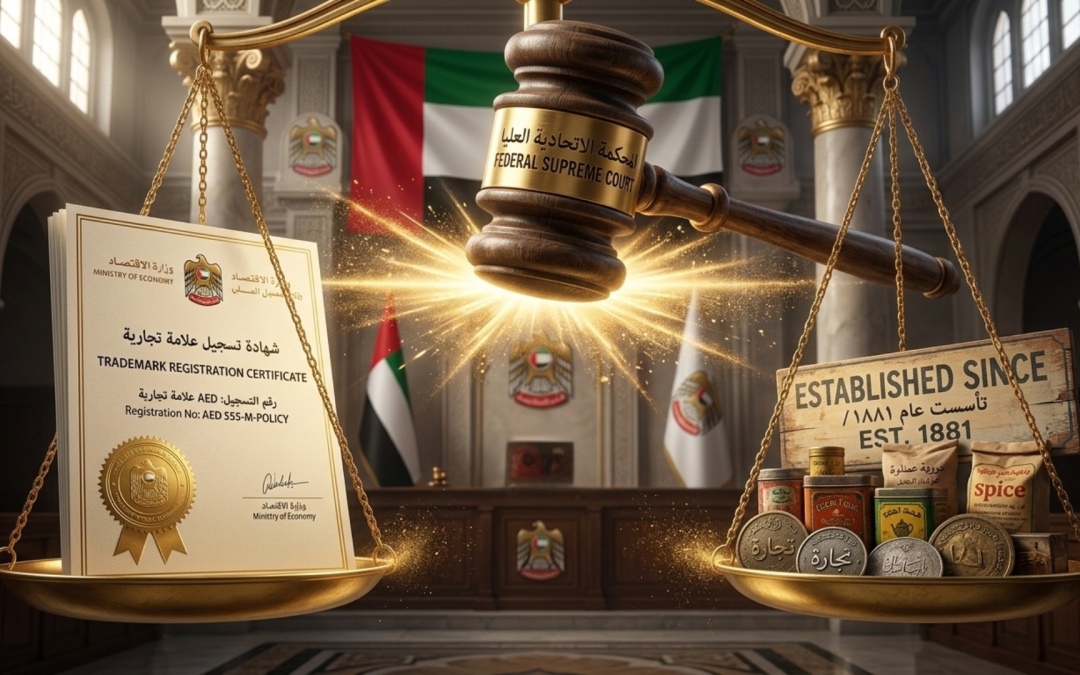
One of the most important principles reaffirmed by the Court is that registration does not, in itself, create trademark ownership. Rather, registration evidences and records the mark, but ownership is fundamentally grounded in priority of use.
Key Points Clarified by the Court
- A registrant is deemed the owner if the mark has been used continuously for at least five years from the date of registration without judicial challenge.
- However, where another party proves prior use before registration, that party may claim ownership and seek cancellation.
In essence, the UAE legal framework recognizes substantive commercial reality over formal registration.
3. Right to Seek Cancellation of Wrongfully Registered Marks
The Court confirmed that any interested party may request cancellation of a trademark registered without legal basis. Once a final judicial judgment is issued ordering cancellation, the competent authority (i.e., the Ministry of Economy) is bound to remove the mark from the register.
This reinforces that the trademark register is not immune from judicial scrutiny. It is a public record subject to correction where registration conflicts with superior rights.
4. Judicial Duty to Address Substantive Defenses
Beyond trademark law, the judgment carries broader procedural importance.
The Court emphasized that judicial decisions must demonstrate that the trial court fully examined:
- The factual matrix,
- The evidence submitted,
- The substantive defenses raised by the parties.
A judgment that merely refers to a lower court’s reasoning without addressing material defenses is legally deficient.
This principle is particularly important in intellectual property disputes, where technical reports (such as expert opinions) often address factual matters but do not resolve legal questions. The Court clarified that experts cannot determine legal ownership; that function remains exclusively judicial.
5. The Core Dispute: Prior Use vs. Registered Title
In the case at hand, the appellant argued that it was the first user of the disputed trademark in the UAE market and therefore the rightful owner under the Trademarks Law. It also sought cancellation of the opposing party’s registration on the basis of prior use.
However, the lower courts relied heavily on the expert report and did not independently adjudicate the legal question of ownership arising from prior use. The Supreme Court found that this omission constituted:
- Defective reasoning,
- Failure to address a decisive defense,
- Violation of the right of defense.
Accordingly, the judgment was overturned and remitted for reconsideration.
6. Practical Implications for Businesses in the UAE

This decision has substantial commercial consequences:
1. Early Market Entry Matters
Businesses that enter the UAE market should maintain documentary evidence of first use — invoices, marketing materials, domain registrations, and advertising campaigns.
2. Registration Remains Critical — But Not Sufficient
While registration strengthens protection, it does not cure defects arising from lack of genuine prior use.
3. Monitor Competitor Filings
Companies should actively monitor trademark filings to prevent opportunistic registrations.
4. Expert Reports Are Not Determinative on Legal Ownership
Technical findings must be supplemented by legal analysis grounded in statutory interpretation.
7. Conclusion: Substance Prevails Over Formality
The ruling in Commercial Appeal No. 800 of 2025 underscores a consistent judicial philosophy: trademark law protects commercial reality, not procedural technicality.
Ownership arises from genuine market use. Registration is evidentiary — not constitutive. Courts must rigorously examine claims of prior use and cannot delegate legal determinations to expert reports.
For businesses operating in the UAE, the message is clear: protect your brand proactively, document your use meticulously, and understand that trademark disputes will ultimately turn on substantive commercial conduct rather than formal registration alone.
If you require further clarification or legal assistance concerning the matters discussed in this article, please do not hesitate to contact Khairallah Advocates & Legal Consultants LLC. Our lawyers would be happy to assist you.
Authors: