

Introduction
Corporate disputes in the UAE often fail not because of weak arguments, but because the claim is filed against the wrong legal person. A recent judgment of the Abu Dhabi Court of Cassation clarified an important principle concerning who has the legal right (standing) to challenge corporate resolutions, particularly within group company structures involving a one-person company (Single Shareholder LLC).
The Court examined whether a shareholder in a parent company may invalidate resolutions issued by the general assembly of a wholly owned subsidiary structured as a single-shareholder company.
Background of the Dispute
A minority shareholder in a parent company filed a commercial claim seeking annulment of resolutions adopted in the general assembly of a subsidiary company.
The subsidiary was incorporated as a single-shareholder limited liability company, entirely owned by the parent company.
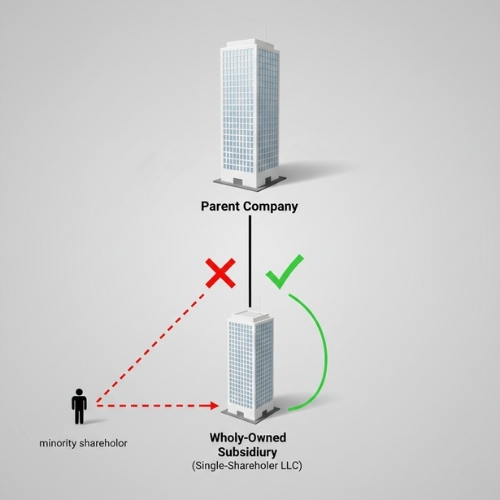
The disputed meeting was conducted electronically. The claimant alleged the resolutions were invalid because:
- the invitation was not issued by the company manager,
- the meeting lacked legal basis,
- and the entity convening the meeting allegedly lacked authority.
The court of first instance dismissed the claim procedurally. The appellate court later invalidated the resolutions. The dispute then reached the Court of Cassation.
Core Legal Question
The Court did not first examine whether the resolutions were lawful. Instead, it addressed the fundamental procedural issue:
- Does a shareholder in the parent company have the right to directly challenge resolutions issued by the general assembly of its wholly owned subsidiary?
Legal Framework Considered by the Court
Under UAE Commercial Companies Law:
- A single natural or legal person may establish a limited liability company.
- Liability is limited to the share capital.
- The general assembly exercises authority over company affairs including financial approval, appointment of managers, and profit distribution.
However, in a single-shareholder company, the general assembly does not operate as a collective body of partners. The Court clarified:
- The general assembly legally represents the will of the sole shareholder itself.
- Thus, the resolutions issued by the subsidiary were legally the expression of the parent company’s will.
Court’s Reasoning
The Court determined that the subsidiary did not independently produce the contested decisions. Instead:
- The parent company = the actual decision-maker
- The subsidiary = the legal vehicle implementing that decision
Therefore, the dispute concerned the will of the shareholder entity, not the operational company.
Legal standing exists only when the claim is brought against the party whose legal position is directly affected by the judgment.
Effect of Minority Shareholding
The claimant held a minority stake in the parent company. The Court ruled that this does not grant automatic authority to challenge the subsidiary’s resolutions directly.
Two procedural defects existed:
- The claimant lacked standing to sue the subsidiary regarding its general assembly decisions.
- The parent company — the real issuer of the resolutions — was not properly sued.
Because the lawsuit targeted the wrong legal entity, the case suffered from defective legal standing and was inadmissible.
Final Judgment
The Court of Cassation overturned the appellate judgment and reinstated the dismissal of the claim, confirming that the case was filed by and against parties lacking proper legal standing. Costs were imposed on the claimant.
Legal Principles Established
1. The “Real Decision-Maker” Principle
In a one-person company, the general assembly represents the will of the sole shareholder. The subsidiary itself is not the independent decision-maker.
2. Corporate Hierarchy Matters
A shareholder in a parent company cannot bypass the corporate structure and directly challenge subsidiary resolutions.
3. Correct Defendant Requirement
The lawsuit must be filed against the entity who’s legal will created the decision.
4. Minority Shareholder Remedies
Minority shareholders must challenge decisions within the parent company framework — not indirectly through subsidiary litigation.
Practical Implications in UAE Corporate Litigation
This ruling significantly affects litigation strategy:
- Misidentifying the defendant can lead to immediate dismissal.
- Corporate group structures provide procedural protection when properly structured.
- Minority shareholders must use internal corporate remedies before judicial challenges.
- Courts focus on legal standing before examining the merits of a dispute.
Conclusion
The Abu Dhabi Court of Cassation reaffirmed a critical procedural rule: A claim challenging corporate resolutions must be directed at the entity that legally expresses the disputed will.
In a single-shareholder LLC, the general assembly is merely an extension of the owner. Accordingly, a challenge must be filed against the shareholder entity — not the subsidiary company.
The case demonstrates that in UAE corporate litigation, procedural standing can determine the outcome even before the court considers the substance of the dispute.
If you require further clarification or legal assistance concerning the matters discussed in this article, please do not hesitate to contact Khairallah Advocates & Legal Consultants LLC. Our lawyers would be happy to assist you.
Authors: