

Executive Summary
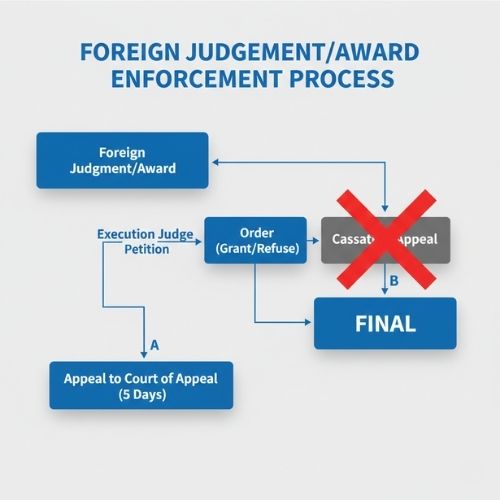
The General Assembly of the UAE Court of Cassation has resolved a longstanding split in Cassation case law over whether an Execution Judge’s order issued on a petition to enforce foreign court judgments and foreign arbitral awards is appealable by way of cassation. In its ruling issued in Application No. 6 of 2025 (General Assembly – Civil), rendered on 18 December 2025, the Assembly adopted the view that such orders are not subject to cassation. Instead, they are appealable only to the Court of Appeal within the statutory five days period, consistent with the special, summary pathway the legislator established for the enforcement of foreign decisions. This unifying principle is binding and will materially streamline cross border enforcement practice in the onshore UAE courts.
I. Context: The Procedural Puzzle Behind Foreign Enforcement in the UAE
With the UAE’s central role in global commerce, parties frequently seek to recognize and enforce foreign judgments and arbitral awards against assets located in the UAE. Under the UAE’s civil procedures regime, the vehicle for recognition and enforcement in onshore courts is typically a petition to the Execution Judge, rather than a full merits action. The goal is procedural economy and speed: the Execution Judge verifies the formal prerequisites for enforcement and issues an order either allowing or refusing execution. The system’s design, however, raised a procedural question that split prior Cassation panels: can litigants take such orders further to the Court of Cassation, or does the appeal track end at the Court of Appeal?
Two conflicting lines of authority emerged.
One permitted cassation review of such orders; the other—grounded in the special nature of orders on petition and the legislator’s streamlined design—held that cassation was unavailable, limiting challenges to the Court of Appeal. The divergence compelled the General Assembly to intervene and unify the rule to ensure predictability and procedural coherence.
II. The Statutory Architecture the General Assembly Relied Upon
The General Assembly’s reasoning is anchored in the post reform civil procedures framework, most notably Federal DecreeLaw No. (42) of 2022 (the Civil Procedures Law) and its implementing rules as referenced in the judgment.
The Assembly emphasizes:
- Article 141 (DecreeLaw 42/2022): establishes the regime for orders on petitions—noncontentious, summary measures issued by the competent court or judge on the basis of a written application without a full adversarial trial. Such orders are a distinct species from judgments rendered in ordinary plenary proceedings.
- Articles 222 and 223 (DecreeLaw 42/2022): define the powers of the Execution Judge and procedural tracks relating to execution measures, including the route for enforcement of foreign decisions. These provisions situate foreign enforcement petitions within the execution architecture, not the general adjudicatory track.
- Article 44 (DecreeLaw 42/2022): prescribes the essential particulars and documentation that must accompany the enforcement petition and fixes the short appeal timeline—five (5) working days—for grievances against such orders.
Appellate Structure and Implementing Regulations (as referenced in the judgment, including the Cabinet decisions that historically governed procedural details): these confirm that orders on petition are not ordinary judgments and that the legislator has channeled appeals directly to the Court of Appeal, preserving the expedition and summary character of the procedure.
The Assembly draws a principled line between (i) judgments issued after an adversarial hearing on the merits—which may, subject to statutory thresholds, reach the Court of Cassation—and (ii) orders on petition in execution matters (including foreign enforcement), which are procedurally exceptional and subject to limited, accelerated appellate control.
III. The Holding: No Cassation From ExecutionJudge Orders in Foreign Enforcement
Having surveyed the conflicting strands of Cassation authority, the General Assembly adopts and unifies the second line of cases and holds:
An order issued by the Execution Judge on a petition seeking enforcement of a foreign court judgment or a foreign arbitral award is not susceptible to appeal by way of cassation. The proper and exclusive route of challenge is an appeal to the Court of Appeal within the statutory five days period.
This holding is categorical. It does not depend on the nature of the foreign decision (judgment or award) nor on whether the Execution Judge grants or refuses enforcement. The decisive feature is the procedural character of the decision—an order on petition within the execution framework—rather than any substantive distinction.
IV. The Assembly’s Reasoning:
A. Orders on Petition Are Not Merits Judgments
The Assembly treats the Execution Judge’s foreign enforcement decision as an order on petition: a summary, document driven, non contentious act that determines enforceability in the UAE on a prima facie basis. It does not adjudicate the underlying merits of the foreign dispute, nor does it arise from a plenary adversarial process. As such, it cannot be assimilated to a “judgment” within the ordinary appellate taxonomy that would open the door to cassation.
B. Legislative Intent Favors Expedition and Finality at the Appellate Level
The reform trajectory culminating in DecreeLaw 42/2022 evinces a clear policy choice: streamline enforcement—especially for foreign decisions—by reducing procedural friction. The five days appeal window and the single appellate tier (Court of Appeal) reflect the legislator’s intent to avoid dilatory tactics and to furnish predictable, swift enforcement. Allowing a further tier of cassation review would frustrate that design and relitigate what is meant to be a summary gatekeeping determination.
C. Systemic Coherence in Execution Matters
The Assembly’s approach harmonizes foreign enforcement orders with the broader category of execution related orders on petition, which the statute channels to the Court of Appeal only. The ruling removes the doctrinal anomaly whereby foreign enforcement orders alone could be escalated to the Court of Cassation, a result incompatible with the text, structure, and purpose of the execution regime.
V. Practical Consequences for Counsel and Parties
1. Appellate Ceiling: Court of Appeal as the Final Word
In onshore UAE courts, the Court of Appeal is now the final judicial instance for challenges to ExecutionJudge orders on foreign enforcement. Counsel must strategically frontload all procedural and substantive objections at this stage; there is no cassation safety net.
2. Compressed Timelines: Five (5) Working Days

The appeal clock runs fast. Parties must file their appeal within five working days of the order’s issuance. Failure to meet this deadline will typically render the order final and enforceable, absent exceptional statutory relief. Law firms should implement alerts and internal workflows to capture orders the day they issue and to prepare appeal papers immediately.
3. Documentary Rigor: Get the File ‘CassationGrade’ at Day One
Although cassation is unavailable, counsel should prepare their petition dossiers as if subject to highest level scrutiny. The core foreign enforcement risks remain documentary:
- Legalization/Apostille (as applicable) proving authenticity of the foreign decision.
- Certified translations into Arabic.
- Proof of finality (res judicata / no further ordinary appeal) in the issuing jurisdiction.
- Due process compliance (proper notice and opportunity to be heard abroad).
- Public policy vetting to preempt refusals under UAE public order principles.
Deficiencies are often fatal at the summary stage, with limited scope to amend appeal given the compressed timeline.
4. Substantive Filters Still Matter
While the path is summary, the grounds for refusal remain material: jurisdictional overreach by the foreign court, contradiction with a UAE judgment, violation of UAE public order, or procedural unfairness may justify nonrecognition. Counsel should address these grounds proactively in the petition rather than waiting for objections.
5. Coordination with Treaty and Arbitration Frameworks
For foreign arbitral awards, the UAE is a New York Convention jurisdiction; the onshore enforcement track is still the Execution Judge petition referenced by the Assembly’s ruling. The Assembly’s principle governs the appeal route, not the recognition criteria themselves. Parties should therefore align petition content with both convention based defenses and UAE public policy, while remembering that any challenge to the order will end at the Court of Appeal.
VI. Conclusion
The General Assembly has delivered much needed certainty: no cassation appeal lies from the Execution Judge’s order (granting or refusing) on a petition to enforce foreign judgments or arbitral awards. Challenges are channeled exclusively to the Court of Appeal, within a five days window. The decision faithfully implements the legislator’s design in DecreeLaw 42/2022 to keep foreign enforcement fast, focused, and final at a single appellate tier.
If you require further clarification or legal assistance concerning the matters discussed in this article, please do not hesitate to contact Khairallah Advocates & Legal Consultants LLC. Our lawyers would be happy to assist you.
Authors: