

Appeal No. 191 of 2025 – Order of Arbitration Petition
Introduction
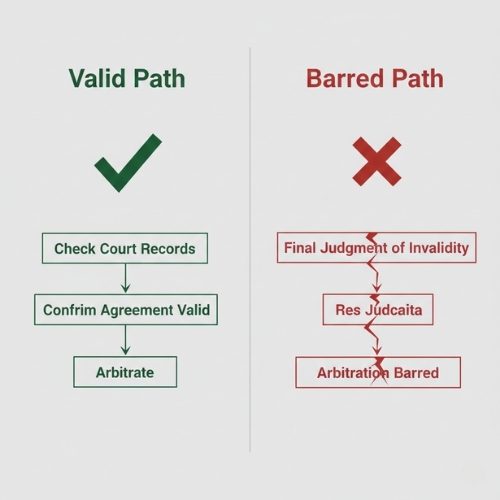
In a significant judgment, the Dubai Court of Appeal clarified the limits of arbitral jurisdiction under UAE law. In its ruling dated 22 January 2026 (Appeal No. 191 of 2025, Order of Arbitration Petition), the Court confirmed that an arbitral tribunal cannot assume jurisdiction. This applies where a final court judgment has already declared the arbitration agreement invalid. The Court held that any attempt by an arbitrator to revive such an agreement constitutes a violation of res judicata and public order, rendering the arbitral decision null and void.
Factual Background
The dispute originated from a Joint Venture Agreement dated 1 June 2023, pursuant to which a joint venture company was established. The venture failed to sustain its commercial activities and incurred losses exceeding its capital. Consequently, court proceedings were initiated seeking dissolution and liquidation of the joint venture entity.
During those proceedings, a jurisdictional objection was raised on the basis of an arbitration clause contained in the Joint Venture Agreement. However, the competent court ruled that the entire agreement, including the arbitration clause, was invalid, as it contravened mandatory legal requirements and public order. This judgment later became final and binding.
Notwithstanding this final determination, arbitration proceedings were subsequently commenced relying on the same arbitration clause. A partial arbitral award was issued by a sole arbitrator on 22 October 2025, asserting jurisdiction over the dispute.

This partial award became the subject of annulment proceedings before the Dubai Court of Appeal.
Issues Considered by the Court
The Court was called upon to determine whether:
-
An arbitrator may lawfully assume jurisdiction where the arbitration agreement has already been declared invalid by a final court judgment;
-
The doctrine of separability of the arbitration clause applies where the underlying contract is void for violation of public order; and
-
A final foreign court judgment may produce res judicata effects before UAE courts in arbitration-related matters.
The Court’s Legal Analysis and Ruling
The Dubai Court of Appeal unequivocally held that judgments that have acquired the force of res judicata are binding and conclusive and cannot be circumvented by resorting to arbitration. Once a court has definitively ruled on a fundamental issue forming the basis of a dispute, the same issue cannot be re-litigated before another forum, whether judicial or arbitral.
The Court relied on Article 87 of Federal Decree No. (53) of 2022 issuing the Law of Evidence in Civil and Commercial Transactions, which enshrines the principle that final judgments preclude the re-opening of disputes where there is unity of parties, subject matter, and cause of action. Importantly, the Court clarified that this provision applies equally to foreign judgments, provided that such judgments are final under the law of the issuing jurisdiction.
The Limits of the Separability Doctrine
While acknowledging the general principle that arbitration clauses are independent from the main contract, the Court stressed that this doctrine is not absolute. Where the underlying contract is declared void ab initio for reasons related to public order or mandatory legal formalities, the arbitration clause embedded within it necessarily falls.
The Court emphasized that separability cannot be used as a mechanism to revive an arbitration agreement that has already been judicially invalidated.
Public Order as a Bar to Arbitrability
The Court further observed that the arbitration agreement in question violated public order, particularly in relation to mandatory corporate formation requirements.
Reference was made to Article 4(2) of Law No. (6) of 2018 on Arbitration, which prohibits arbitration in matters that are not capable of settlement or reconciliation.
Disputes arising from agreements that are void due to non-compliance with statutory requirements fall outside the scope of lawful arbitration. Party consent cannot cure this defect.
The Res Judicata Effect of Foreign Judgments in the UAE
A key aspect of the ruling is the Court’s confirmation that foreign judgments, once proven to be final and conclusive under the law of the issuing state, may have binding res judicata effect before UAE courts. The Court rejected the argument that only domestic judgments can trigger res judicata, holding instead that the principle applies universally when its legal conditions are satisfied.
The Court’s Final Decision
Based on the above reasoning, the Dubai Court of Appeal ruled to:
-
Annul the partial arbitral award asserting jurisdiction;
-
Declare the arbitrator’s decision as legally ineffective; and
-
Order the respondent to bear court costs and attorney’s fees, pursuant to Article 133 of the Civil Procedures Law.
Practical Implications for Arbitration Practice
This judgment provides critical guidance for arbitration practice in the UAE:
-
-
Arbitrators must verify the continued legal validity of arbitration agreements before asserting jurisdiction;
-
-
Final court judgments cannot be bypassed through arbitration proceedings;
-
The separability doctrine does not protect arbitration clauses embedded in contracts void for public order violations; and
-
Foreign judgments, once final, may decisively bar arbitration proceedings in the UAE.
Conclusion
Appeal No. 191 of 2025 stands as an authoritative reaffirmation of judicial supremacy over arbitral jurisdiction in cases involving invalid arbitration agreements. It reinforces the principle that arbitration is a consensual mechanism bounded by legality, public order, and the finality of judicial determinations. Parties and arbitrators alike must exercise heightened diligence when invoking arbitration clauses, particularly in cross-border and corporate disputes.
Authors: