

A Paradigm Shift in Regulation, Governance, and Investor Protection with the New UAE Capital Markets Framework. The introduction of Federal Decree-Law No. 33 of 2025 concerning the Regulation of the Capital Market represents a landmark development in the evolution of the United Arab Emirates’ financial regulatory landscape.
This legislation replaces fragmented and legacy capital markets regulations with a comprehensive, modern, and principles-based framework designed to enhance transparency, strengthen investor protection, and align the UAE with leading international financial jurisdictions.
The new regime reflects a deliberate policy shift toward positioning the UAE as a globally competitive capital markets hub capable of supporting sophisticated financial products and cross-border investment activity.
At its foundation, the law establishes a unified legal framework governing securities, foreign securities, investment funds, virtual assets for investment purposes, capital market institutions, and licensed financial activities.
Unlike prior regimes that were primarily territorial in scope, the new law applies not only to activities conducted within the UAE but also to offshore entities and individuals whose activities target investors in the State.
This expanded scope significantly enhances regulatory oversight and closes structural loopholes previously exploited through offshore arrangements and indirect solicitation models.
Institutional Reform: Establishment of the Capital Markets Authority
The regulatory framework is reinforced by Federal Decree-Law No. 32 of 2025, which establishes the Capital Markets Authority as the successor to the former Securities and Commodities Authority.
The Capital Markets Authority is constituted as an independent federal authority with legal personality, financial and administrative autonomy, and broad supervisory and enforcement powers, reporting directly to the UAE Cabinet.
This institutional elevation reflects a shift from reactive supervision toward proactive market development, systemic risk management, and strategic regulatory oversight.
The Authority’s mandate extends well beyond licensing and compliance. It includes rulemaking, inspections, enforcement actions, administrative sanctions, coordination with domestic and foreign regulators, and oversight of market integrity.
While the Authority’s jurisdiction excludes financial free zones, it retains extensive powers over onshore capital market activity, ensuring regulatory clarity while preserving the autonomy of established financial free zones.
Expanded Scope of Application and Extra-Territorial Reach
One of the most consequential aspects of the new capital markets regime is its expansive scope of application.
The law applies to issuers, licensed persons, approved persons, investment funds, market institutions, and any individual or entity conducting regulated capital market activities within the UAE or targeting UAE clients, regardless of where such activities are physically conducted.
This approach introduces a form of regulatory extra-territoriality designed to protect UAE investors and maintain market integrity in an increasingly digital and borderless financial environment.
The law adopts a balanced approach by excluding securities issued by the Federal Government or local governments unless such securities are offered to the public or listed on a market.
Similarly, government-owned investment funds are excluded unless they engage in public offerings or listings.
These exclusions preserve sovereign flexibility while maintaining transparency and investor safeguards where public participation is involved.

Regulated Financial Activities and Licensing Discipline
The law provides a comprehensive and detailed classification of regulated financial activities subject to the Authority’s licensing, supervision, and oversight. These activities include:
- Brokerage,
- Underwriting,
- Portfolio management,
- Custody,
- Investment advisory services,
- Issuance management,
- Securitisation, and
- Operation of markets and trading platforms.
Importantly, the framework also captures emerging sectors such as virtual assets for investment purposes, investment-based crowdfunding, and fintech-enabled capital market services.
A central pillar of the regime is the strict prohibition against conducting any regulated financial activity without prior licensing or approval from the Capital Markets Authority.
Licenses are activity-specific and subject to fit-and-proper assessments, financial solvency requirements, governance standards, guarantees or insurance coverage, and continuing compliance obligations.
This significantly raises the compliance threshold for promoters, introducers, offshore platforms, and unlicensed intermediaries engaging with UAE investors.
Corporate Governance, Executive Accountability, and Regulatory Intervention
The new regime imposes robust corporate governance obligations on licensed persons and market institutions.
Board members, executive management, and designated employees are subject to prior approval by the Authority, and licensed entities are held fully responsible for the acts and omissions of their employees, affiliates, and outsourced service providers.
This framework effectively eliminates reliance on outsourcing or nominee structures as a means of diluting regulatory accountability.
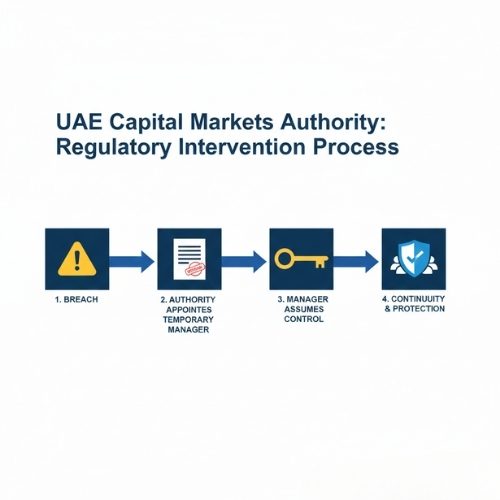
A particularly powerful feature of the law is the Authority’s ability to appoint a temporary manager where a licensed entity breaches solvency requirements, fails to comply with prudential obligations, or commits serious regulatory violations.
The Temporary Manager’s Powers and Role
The temporary manager may assume operational control, restrict board powers, and bind the entity through their decisions.
This mechanism ensures continuity of critical functions, safeguards client interests, and mitigates systemic risk during periods of financial or governance distress.
Protection of Client Funds and Asset Segregation
Investor protection is a defining theme of the new capital markets framework.
Licensed persons are required to segregate client funds and securities from their own assets at all times.
Client assets are expressly excluded from the licensed person’s insolvency estate and are protected from attachment, enforcement, bankruptcy, or liquidation proceedings against the licensed entity.
This statutory segregation provides strong legal certainty and aligns the UAE with leading international custodial and insolvency protection standards.
In the context of margin trading, licensed persons are granted priority enforcement rights over collateral held in client accounts, subject to regulatory controls.
This balances the need for market stability and risk management with appropriate safeguards for clients and creditors.
Disclosure Obligations, Market Conduct, and Insider Dealing
The law introduces a sophisticated disclosure and market conduct regime applicable to issuers, foreign issuers, insiders, and related parties.
Issuers are subject to ongoing disclosure obligations in relation to material information that may affect investment decisions, market prices, or trading volumes.
Misleading statements, selective disclosure, and failure to disclose material information are expressly prohibited.
Insiders, including board members, executive management, and employees with access to non-public information, are subject to strict prohibitions on insider dealing and unlawful disclosure of inside information.
Blackout periods and disclosure obligations apply to trading in both issuer securities and securities of related entities, significantly increasing accountability at senior management and shareholder levels.
Strategic Implications for Market Participants
From a strategic standpoint, the new capital markets framework elevates regulatory compliance from a procedural exercise to a core governance and risk management function.
Issuers must reassess disclosure controls, prospectus liability, board oversight mechanisms, and related-party transaction governance.
Financial institutions must review licensing scopes, cross-border marketing practices, outsourcing arrangements, and alignment with anti-money laundering and counter-terrorist financing obligations.
For investors, the framework enhances transparency, enforceability of rights, and protection of assets, strengthening confidence in the UAE’s capital markets.
For the UAE as a jurisdiction, the legislation reinforces its position as a credible, well-regulated, and internationally aligned financial centre capable of supporting complex capital market activity and institutional investment flows.
Conclusion
The introduction of the new capital markets regime, together with the establishment of the Capital Markets Authority, represents a decisive step in the maturation of the UAE’s financial regulatory environment.
It reflects a clear policy commitment to investor protection, market integrity, and sustainable financial development.
Market participants who proactively adapt to this framework will be well positioned to benefit from the UAE’s next phase of capital market growth, while those who fail to do so face heightened regulatory, civil, and enforcement risk.
If you require further clarification or legal assistance concerning the matters discussed in this article, please do not hesitate to contact Khairallah Advocates & Legal Consultants LLC. Our lawyers would be happy to assist you.
Authors: