
The Critical Need for a Will
In the absence of a Will, the UAE courts apply Sharia inheritance principles by default to the UAE-based assets of a Muslim expatriate, as governed by Federal Decree-Law No. 41 of 2024.
While Sharia law provides a structured system of succession, it does not always reflect modern family arrangements, commercial realities, or cross-border asset structures commonly encountered by expatriates.
Without a Will, there is no scope to accommodate personal priorities such as non-traditional heirs, business partners, or charities. This can potentially cause family disputes or business disruptions.
A Will provides clarity, appoints trusted executors, and ensures the orderly transfer of UAE assets, including:
-
Real estate
-
Bank accounts
-
Shares in onshore or free zone entities.
Sharia Inheritance Rules
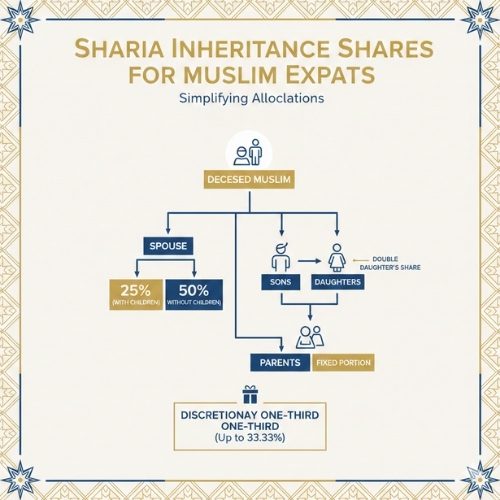
Sharia law governs Muslim estates by default in the UAE, mandating fixed shares for heirs like spouse, children, parents, and siblings based on family composition. It favors sons over daughters.
Key principles involve:
-
Fixed shares for spouses (e.g., ¼ with children, ½ without).
-
Sons receive double the share of daughters.
-
Parents receive a fixed portion.
-
The general rule is that assets go to legal heirs as defined by Islamic law, unless limited by a valid Will stating otherwise.
This forced heirship prioritizes blood relatives and leaves up to one-third of the estate for discretionary bequests (like debts, gifts, or charities). The rest follows strict formulas regardless of the deceased’s wishes.
For expatriates, this applies only to UAE assets under Federal Decree-Law No. 41 of 2022 and Federal Decree Law No. 5 of 1985 to be replaced by Federal Decree Law No. 25 of 2025, creating conflicts with home country laws or joint holdings, often complicating probate and exposing estates to prolonged litigation.
Why Civil Wills Matter
For Muslim expatriates in the UAE, a civil Will offers a practical and structured method of estate planning that works alongside, rather than in place of, Sharia-based inheritance rules.
It allows the testator to:
-
Clearly identify UAE-based assets (real estate, bank accounts, investments, business interests), reducing ambiguity during probate.
-
Appoint trusted executors, avoiding procedural delays associated with court-appointed administrators.
-
Provide a framework for business succession, particularly where company shares or commercial interests are involved.
Potential Consequences Without a Civil Will
In the absence of a registered civil Will, Sharia-driven probate procedures can expose an estate to significant disruption. UAE authorities typically restrict access to assets upon notification of death until court orders confirm heirs and settle liabilities.
In practice, this may result in:
Assets Freezing
Banks, land departments, and investment firms block all UAE assets—whether held individually or jointly—halting access for surviving spouses or dependents. This often lasts for weeks or months, creating urgent financial hardship during a time of grief.
Joint Account Blocking
Access to joint funds is prevented, including daily living expenses, bill payments, and other financial obligations until probate is formally completed. This creates significant financial and emotional hardship for the surviving family.
Business Share Deadlock
Shares in onshore companies or free zone entities cannot be transferred or managed. Multiple Sharia heirs may fragment ownership, forcing unwanted liquidations or operational paralysis.
Guardianship Dispute
Courts determine custodianship of minor children in accordance with Sharia principles, potentially leading to family disputes.
A properly drafted civil Will significantly mitigates these risks. It facilitates smoother estate administration, protects business continuity, permits guardianship nominations, and provides heirs with much-needed clarity at a sensitive time.

How Our Legal Team Can Help
At Khairallah Advocates & Legal Consultants, we assist Muslim foreign residents through every stage of civil Will planning.
Our service includes:
-
Advising on the interaction between Sharia inheritance rules and UAE civil laws.
-
Drafting bespoke and enforceable bilingual Wills.
-
Structuring business and family succession to avoid conflicts or unintended revocation.
-
Coordinating registration with the judicial departments.
-
Providing post-execution support to ensure smooth probate and ongoing compliance with evolving UAE legal frameworks.
Conclusion
For Muslim expatriates residing in the UAE, estate planning should never be left to default legal outcomes. While Sharia law governs inheritance as a matter of principle for Muslims, a carefully structured civil Will plays a vital role in bringing clarity, efficiency, and legal certainty to the administration of UAE-based assets.
By putting a compliant civil Will in place, individuals can:
-
Protect their families.
-
Safeguard business continuity.
-
Reduce the risk of disputes or delays at a critical time.
A civil Will is therefore a critical legal safeguard, not merely a procedural formality.
Legal Disclaimer: This blog is provided for informational purposes only and does not constitute legal advice. For personalized advice and regulatory updates, reach out to Khairallah Advocates & Legal Consultants contact.
Authors: